
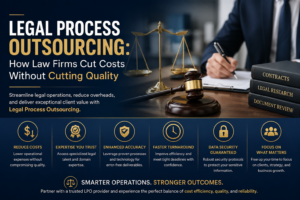
Ask any managing partner what limits their firm’s growth and you’ll hear the same answer: billable hours are finite, and good support staff are expensive. Legal process outsourcing (LPO) exists to solve exactly that problem — and in 2026 it has moved from experiment to standard practice for firms of every size.
What LPO actually covers
Legal process outsourcing is not about replacing lawyers. It is about moving the high-volume, process-driven work that consumes attorney and paralegal time to trained legal professionals offshore. Typical LPO services include:
- Legal research and memoranda — case law research, statutory analysis, and first drafts of memos.
- Document review — discovery review, contract review, and due diligence support.
- Drafting support — pleadings, demand letters, contracts from templates, and deposition summaries.
- Litigation support — cite-checking, exhibit preparation, docketing, and case file organization.
- Paralegal services — intake processing, medical record summarization, and e-filing support.
The quality question — answered
The most common objection to LPO is quality. It’s a fair concern, and the answer lies in how modern LPO operations are structured. Reputable providers staff law graduates trained on the client’s jurisdiction and practice area, run multi-level review before anything reaches the client, and work inside the client’s own templates, style guides, and matter management systems.
The result: work product arrives at the supervising attorney as a strong first draft rather than a blank page. The attorney’s role shifts from production to review — exactly where their judgment adds the most value, and exactly what professional responsibility rules require.
The economics for law firms
An experienced paralegal in a major US market costs $60,000–$85,000 per year before benefits, software, and office space. A dedicated offshore legal professional with equivalent output typically costs 50–70% less — with time zone advantages as a bonus. Work assigned at the end of the US business day is frequently completed overnight and waiting in the morning.
For firms billing fixed fees or working contingency matters, that margin difference flows straight to profitability. For corporate legal departments, it means stretching a flat budget across a growing workload.
Where to start
Firms that succeed with LPO start narrow and expand:
- Pick one repeatable workflow — deposition summaries, demand letters, or intake processing are ideal first candidates.
- Document the process once — templates, examples of good output, and review criteria.
- Run a paid pilot — measure turnaround, revision cycles, and attorney time saved over 30–60 days.
- Scale what works — add practice areas and volume as trust builds.
Key takeaways
- LPO shifts process work offshore so attorneys spend their time on judgment, strategy, and clients.
- Structured training, review layers, and client templates are what protect quality.
- Cost savings of 50–70% on support work are typical and compound as volume grows.
Want to see what a dedicated legal support team would cost for your practice? BHA World Staffing provides trained paralegal professionals and legal process teams for firms worldwide. Book a call to scope your first pilot.