
Abstract
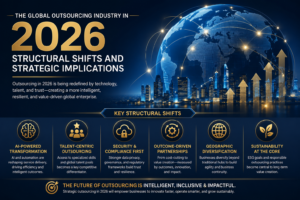
The global outsourcing industry, now exceeding several hundred billion dollars in annual value, is undergoing its most significant structural transition since the rise of offshore delivery in the early 2000s. This journal examines three converging forces — artificial intelligence augmentation, the shift from cost arbitrage to capability arbitrage, and the normalization of distributed work — and considers their implications for organizations that buy outsourced services.
I. From cost arbitrage to capability arbitrage
The first generation of offshore outsourcing sold a single proposition: identical work at lower wages. That proposition remains real, but it no longer differentiates providers, because the labor-cost gap is available to every buyer. What increasingly differentiates outcomes is capability — domain-trained talent, engineered processes, compliance infrastructure, and analytics — delivered at offshore economics.
The evidence is visible in what buyers now procure. Contracts specify recovery rates, turnaround times, and quality scores rather than headcount. Providers in legal services, receivables management, and finance operations compete on trained specialization: paralegals versed in specific jurisdictions, collections agents certified on Regulation F, accountants fluent in the client’s ERP. The offshore wage advantage funds this specialization; it is the specialization, not the wage, that wins the engagement.
II. Artificial intelligence as complement, not substitute
Predictions that AI would eliminate outsourced work have, so far, inverted. Automation has absorbed the most routine layer of tasks — data extraction, template correspondence, payment matching — while simultaneously increasing demand for human judgment at the layer above: exception handling, dispute resolution, negotiation, quality assurance, and oversight of the automation itself.
The economic consequence is a restructuring of the outsourced workforce rather than its reduction. Providers now deliver blended operations in which software executes volume and trained staff manage variance. For buyers, this raises the evaluative bar: the relevant question is no longer a provider’s headcount price but its fluency in orchestrating human-plus-machine workflows.
III. Distributed work as the permanent baseline
The normalization of remote collaboration has dissolved the psychological barrier that once separated “our office” from “their delivery center.” Organizations that manage domestic remote employees through dashboards, asynchronous briefs, and video standups apply the same mechanics to offshore teams without friction. The practical effect is that dedicated offshore staffing — individuals embedded in the client’s tools, meetings, and culture — has displaced the transactional, ticket-based model across much of the industry. Outsourcing increasingly resembles distributed employment rather than vendor management.
IV. Strategic implications for buyers
Three implications follow for organizations engaging the industry in 2026:
- Select for process maturity, not price position. Providers able to document training, quality control, and compliance regimes convert offshore economics into durable outcomes; the cheapest bidder rarely can.
- Buy the blend. Engagements should be evaluated on how intelligently the provider combines automation with human expertise, because that ratio now determines both cost and quality trajectories.
- Treat offshore teams as organizational extensions. The highest-performing engagements integrate offshore staff into the buyer’s systems and cadence, capturing the retention, context, and ownership effects of direct employment at outsourced cost.
Conclusion
The outsourcing industry of 2026 no longer sells distance from work; it sells engineered capability at global economics. Organizations that update their procurement lens accordingly — from headcount arbitrage to capability partnership — will capture disproportionate value from the transition.
BHA World Staffing publishes this journal series to examine the forces shaping global staffing and outsourcing. To discuss how these shifts apply to your organization, contact us.