
Abstract
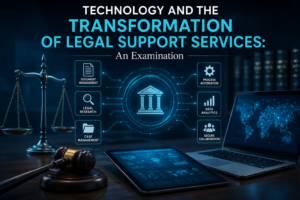
Legal support services — research, drafting, review, and litigation support — are being restructured by three technologies: machine-assisted document analysis, workflow and matter-management platforms, and generative drafting tools. This journal examines the pattern of that restructuring and argues that its principal effect is to reposition human legal expertise toward supervision, exception handling, and judgment, a repositioning that strengthens rather than weakens the case for specialized legal process outsourcing.
- The automation of first-pass work
Document review offers the clearest case study. Technology-assisted review, now standard in discovery, reliably ranks and clusters documents by relevance, reducing the volume requiring human eyes by an order of magnitude. Generative tools extend the same pattern to drafting: first drafts of routine contracts, demand letters, and summaries are increasingly machine-produced.
What automation has not produced is finished legal work. Machine output requires validation against facts, jurisdictional rules, and client context; privilege calls, responsiveness disputes, and novel clauses remain human territory. The consequence is a shift in the shape of legal support labor: less production of first passes, more review, correction, and certification of machine first passes.
- Why the human layer migrated offshore
The economics of the review-and-exception layer favor scale and specialization. A supervising attorney’s hourly cost makes them the wrong resource for validating a thousand machine-classified documents; a domestic paralegal improves the equation only marginally. Trained offshore legal professionals — law graduates schooled in the client’s jurisdiction, working within multi-level quality control — perform the same validation at 50–70% lower cost, with overnight turnaround as a structural bonus of time-zone offset.
This is the substantive change in legal process outsourcing over the past decade: the industry no longer sells typing and formatting. It sells a trained human layer engineered to sit between automation output and attorney sign-off — cite-checking machine research, verifying machine-flagged documents, completing machine-drafted instruments to filing standard.
III. Quality control as the decisive discipline
The credibility of this restructured model rests entirely on quality architecture. Mature legal support operations exhibit a consistent design: recruitment restricted to legal graduates; jurisdiction- and client-specific training with testing; tiered review in which senior reviewers audit samples of all output; error logging with root-cause feedback; and work product delivered inside the client’s own templates and systems, preserving supervising counsel’s ability to review efficiently and discharge professional-responsibility obligations.
The same architecture answers the confidentiality question. Controlled delivery environments, role-based access, encrypted channels, and audited certifications (ISO 27001, SOC 2) have become baseline requirements rather than differentiators.
- Implications
For law firms and corporate legal departments, three conclusions follow:
- The billable unit of legal support is becoming the validated deliverable, not the hour. Procurement and pricing should follow.
- Capacity strategy should assume the blend. The efficient frontier pairs automation platforms with a trained offshore review layer and reserves onshore attorneys for judgment, strategy, and client counsel.
- Provider selection is quality-architecture selection. Training regimes, review structures, and security certifications predict outcomes; headline rates do not.
Conclusion
Technology has not removed people from legal support; it has changed what the people are for. The organizations capturing the efficiency dividend are those that pair machine production with an engineered human validation layer — and the economics of that layer point, decisively, offshore.
BHA World Staffing’s legal process teams provide trained paralegal and legal support professionals for firms and legal departments worldwide. Contact us to discuss your legal operations.